


Monday motivation is not about hyping yourself up with a quote and hoping it sticks. It is about removing the friction that makes Monday feel heavy in the first place. Most people search for Monday motivation on a day when they already feel behind, tired, or dreading the week ahead. A quote alone will not fix that. What actually works is a small set of habits that change how your brain approaches the first day of the week.
This guide breaks down why Mondays feel harder than other days, how to build real motivation instead of borrowed energy, and what to do when low motivation on Monday is a sign of something bigger than a rough morning.
What Monday Motivation Really Means
Monday motivation gets treated like a mood you either have or do not have. In practice, it is closer to a system. People who consistently start their week well are not naturally more disciplined on Mondays. They have simply removed the decisions and friction that drain energy before the day even starts.
The phrase is also used two different ways online. Some people search for Monday motivation quotes to share on social media or with a team. Others search for it because they genuinely feel stuck and want a way to shift their mindset before a demanding week. Both needs matter, and this guide covers both.
Why Monday feels Harder than other Days
There is a real, well-documented reason Mondays feel different. After two days without a strict schedule, your brain has to re-engage decision-making, planning, and task switching all at once. This is sometimes called the “Monday effect,” and it shows up as lower energy, slower starts, and a mental resistance to beginning work.
1. The Sunday Night Dread Connection
Low Monday motivation often starts the night before, not the morning of. Many people spend Sunday evening thinking about everything unfinished from the previous week, which raises anxiety and makes it harder to fall asleep well. That poor sleep then shows up Monday morning as low energy, which gets mislabeled as laziness or lack of motivation.
If Sunday nights consistently feel anxious rather than restful, the fix usually needs to start on Sunday, not Monday. A short planning session the evening before removes a large part of that mental load.
How to Build Real Monday Motivation
Motivation that lasts is built through a sequence, not a single trick. The order below works because each step reduces the effort needed for the next one.
1. Do a five-minute Sunday reset
Before the weekend ends, write down the three things that matter most for Monday. This is not a full to-do list. It is a short filter that stops your brain from replaying unfinished tasks while you are trying to relax or sleep.
2. Protect the First Hour of Monday Morning
The first hour sets the tone for the rest of the day. Avoid opening email or a group chat as the very first task, since that hands control of your morning to other people’s priorities. Instead, start with the task you already identified as most important the night before. Keeping that energy going into Tuesday is usually the harder part, once Monday’s initial push wears off
3. Use the two-minute Start Rule
Motivation seldom comes before action; it comes after. Commit to working on a task for just two minutes with no pressure to finish it. Momentum tends to build once you have already started, which is why the hardest part of Monday is usually the first two minutes, not the whole day. On days that momentum still doesn’t show up, a quote to reset with mid-week can work as a quick mental nudge.
4. Separate Physical Energy from Mental Motivation
Low energy and low motivation feel identical but need different fixes. If you slept poorly or skipped breakfast, no amount of motivational thinking will compensate for that. Handle the physical basics first: hydration, food, and a short walk if possible, before assuming the problem is purely mental.

Monday Motivation Quotes that Actually Help
Quotes work best as a short reset, not a substitute for a real plan. These are useful because they focus on action rather than vague inspiration.
“You don’t have to be great to start, but you have to start to be great.” This line works because it removes the pressure of a perfect Monday and replaces it with permission to simply begin.
“Discipline is choosing between what you want now and what you want most.” This reframes Monday motivation as a short-term trade rather than a personality trait you either have or lack.
“Small daily improvements are the key to staggering long-term results.” This is useful specifically for Mondays because it lowers the bar from a dramatic restart to one manageable step.
Monday Motivation for Remote Workers
Remote work removes the natural transition that used to separate weekend mode from work mode, like commuting or getting dressed for an office. Without that transition, many remote workers report that Monday feels like it blends directly into Sunday, which makes starting harder.
A simple fix is to recreate a small transition ritual. This can be as short as a ten-minute walk before opening a laptop, or changing clothes even when working from home. The goal is to give your brain a clear signal that work mode has started, since remote work removes most of the natural cues that used to do this automatically.
Monday Motivation for Managers and Teams
If you manage a team, Monday motivation is partly your responsibility to shape, not just something each person figures out alone. Opening the week with a status report review or a list of overdue items sets a defensive, reactive tone for everyone.
A better approach is starting the week with a short check-in focused on priorities rather than problems. Ask what each person is focused on this week, not just what went wrong last week. This single change shifts the emotional tone of Monday from catching up to moving forward.

Teams that consistently perform well tend to treat Monday as a planning day rather than a full execution day. Blocking the first hour or two for setting priorities, before diving into deep work, tends to reduce the sense of being overwhelmed that many people associate with Mondays.
When Low Monday Motivation is Something More
Occasional low motivation on Mondays is normal and usually fixable with better routines. It becomes a different issue if the dread is constant, severe, or extends well beyond Monday itself.
Signs worth paying attention to include persistent low mood that lasts most of the week, ongoing trouble sleeping, or a loss of interest in things you normally enjoy. These patterns can point toward burnout or a broader mental health concern rather than a simple case of the Monday blues. This is not something a motivational routine can fix on its own.
If low motivation is paired with these signs and has lasted more than a couple of weeks, it is worth speaking with a doctor or mental health professional. They can help identify whether the cause is workload, sleep, burnout, or something else that needs a different kind of support.
Simple Habits that Sustain Motivation Past Monday
Monday motivation only matters if it carries into the rest of the week. A few habits make that more likely.
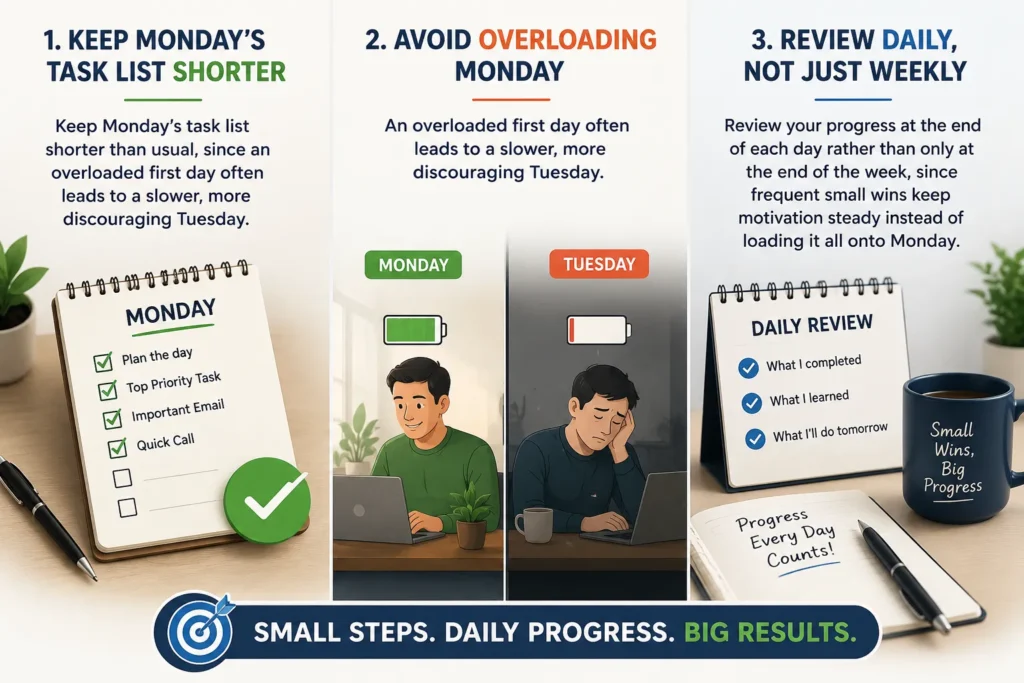
Keep Monday’s task list shorter than usual, since an overloaded first day often leads to a slower, more discouraging Tuesday. Review your progress at the end of each day rather than only at the end of the week, since frequent small wins keep motivation steady instead of loading it all onto Monday.
Finally, treat rest on the weekend as part of the system rather than separate from it. Motivation on Monday is often just the visible result of how well the two days before it were spent.